Clan Armstrong
INVICTUS MANEO
The legends of clan Armstrong say that the earliest ancestor was Siward Beorn ('sword warrior'), also known as Siward Digry ('sword strong arm'). Another traditional story claims that an armour bearer by the name of Fairbairn rescued his master, the king of Scotland, mid battle by pulling him onto his horse by the thigh. Fairbairn was allegedly later given the name "Armstrong" and granted lands in the Borders.
It was in this border region between Scotland and England that clan Armstrong because one of the most historically powerful clans in the country's history. Between the 13th and 17th century the Scottish Borders were in turmoil, with anything between personal rivalries and all-out war common between the two countries. The Armstrongs were arguably the most dangerous clan during this period, with King James V of Scotland believing they were a threat to even his authority. They were feared Border Reivers and warriors up until the Union of the Crowns in 1603, which ended the Anglo-Scottish wars.
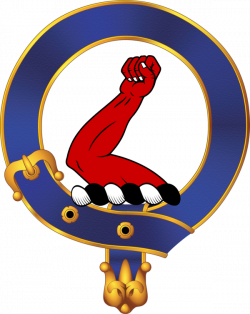
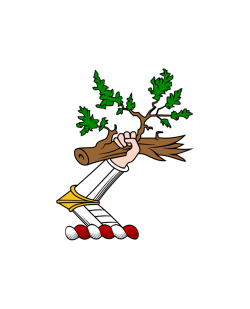
The Armstrong clan motto is "Invictus Maneo" (I Remain Unvanquished) and the clan crest is an embowed arm.


Scottish History
of Clan Armstrong
Saving the King
As the name suggests, the Armstrong Clan are people renowned for their strength. Traditionally armour bearers to the King of Scots, this serious post virtually meant the King’s life was in their hands.
It was an act of bravery and strength in the middle of a hard fought battle which confirmed the Armstrong name and established the Clan.
The King’s horse had been killed and he was trapped beneath the animal’s dead weight. Seeing this, the King’s armour bearer lifted the horse to free his King and so save his life. Another version of the legend says he grabbed the King by the thigh and swung him onto the back of his own steed to escape.
However it happened, the King was duly grateful, praised his armour bearer for saving his life and set the name Armstrong in the history books for ever. His thank you gift was a little matter of spectacular rolling hills and dales in Liddesdale valley, Roxburghshire. That’s where the Clan flourished, particularly in the 13th century.
Ten clan chiefs have been counted but the last one died in 1610. After that the clan scattered abroad. But in those intervening centuries the Armstrongs were famous in that Borders area as reivers or raiders.
Contentious territory, the great swaths of land between the Rivers Esk and Sark changed hands between England and Scotland at least 13 times in those blood-thirsty days. As part of the frequent raids to steal cattle, and horses, (occasionally women too) the surrounding houses and crops would be torched. After cattle had been stolen the owner had 24 hours to go in hot pursuit. He did this with a burning peat at the tip of his lance to warn everyone what he was about and to clear out of his road. If he was successful and found his livestock in that time, he was supposed to be able to reclaim it without question. But if more than 24 hours had elapsed, it was a case of finder is keeper and he’d have to fight for the return of his property.
Reiving, or raiding of this kind was the business of the day. And the Armstrongs with their great allies the Elliots, were foremost among the Border Reivers. They ran, what might be called today, protection rackets – pay us and we’ll protect you and your property. But they were men of honour and woe betide the man who didn’t keep his word.
Life for the ordinary Reiver on raiding forays was rough. Shelter was a fairly flimsy affair of bowed trees and pine branches which could be created as quickly as it would invariably, be destroyed. Firing of the land was commonplace and a natural event in the course of a raid. The Thieves’ Road and the Captain’s Road are still used but nowadays it will be walkers on the Southern Uplands Way who enjoy the majesty of the fine hill tracks. In days gone by these were the Drove Roads where the herds of sheep and cattle were brought to markets or where the Reivers clandestinely led their newly acquired stock.
When Castleton was burned to the ground it was re-created three or four miles away and re-named Newcastleton. The place can still be found today, but in a more substantial form, at the edge of the Cheviot Hills.
Always war-like, the Armstrongs could be described as mercenaries. In one infamous battle when they had been hired by an English Baron, they discovered with horror, they were fighting their own clansmen on the opposing side. The Armstrongs on the English side immediately stripped off their St George’s Cross garb and joined their kin on the other side to defeat the army they’d originally been hired by. This gave rise to the acidic comment that the Armstrongs are ‘bonnie fechters if they kent which side they were on’.
They so lived up to their reputation as unruly that a Keeper of Liddesdale was appointed by the monarch to attempt to keep them in check. Things reached a degree of settlement in 1552 when the French Ambassador was chosen as the ‘referee’ to supervise the division of the bitterly disputed territories between the River Sark and Esk. This brought some peace to the area.
But not all Armstrongs were of a quarrelsome nature. Gilbert Armstrong was Steward of the Household to King David III around 1363 so knew how to keep the peace in the royal chambers. He eventually became Scotland’s ambassador to England which enabled him to play a part in establishing diplomatic relations between the two nations.
Alexander was the name of the first clan chief. He held sway in Mangerton, the family seat, at the end of the 13th century. At that time the Borders was roughly divided into three parts – the West March, the Middle March and the East March. Each March was jealously guarded territory. Most of the Armstrongs lived in the west end of the Middle March towards the south of the village of Castleton. Their long time friends and fighting companions the Elliots, generally inhabited the areas to the north.
To this day, the Riding of the Marches is a tradition which reflects those troubled times when marking out, establishing, keeping or re-taking territory was so important.
At the height of the Armstong power, the Lairds of Mangerton presided over as many as 80 or 90 sturdy, stone built, tower houses and an estimated 250 farms in their hard-won lands. They were guardians of all the clans who lived there, including the fighting men, the Reivers who with their families, had their lives disrupted by the frequent and violent raids, fire and destruction.
Naturally, covetous eyes would be cast over such extensive land and power.
Betrayal!
The first written account of an Armstrong is, as one might expect, in the court reports of Carlisle. In the 13th century this was a key stronghold and border town of great strategic importance. As far back as 1018 it was part of Cumbria which together with Strathclyde and Lothian were all under the Scottish Crown. Duncan Irving of Eskdale was Governor of Cumbria and had his official residence in Carlisle. But his private retreat was in Upper Eskdale in Dumfriesshire. So commuters are not confined to the 20th century. Those Carlisle law records of 1235 note an Adam Armstrong of Cumberland was pardoned for ‘causing the death of another man.’ The circumstances are not recorded but the fact that he was pardoned showed the crime was considered to have been accidental otherwise he would have been hung.
Only a generation later in 1281 a John Armstrong is stated to have been killed by a James de Multon. This was serious as they were both high ranking nobles. The diplomatic wheeling and dealing required King Alexander III of Scotland to obtain a pardon from his brother-in-law King Edward I of England. This makes it clear that John Armstrong was Scottish and of high rank if his King was concerned in the matter.
It is worth remembering that some of the Normans who landed with William the Conqueror and were so successful in Sussex in 1066, moved north. In time, some settled in the Borders and even further into Scotland. They included another nobleman called Robert de Brus. So James de Multon’s pedigree can be deduced.
The unfortunate, dead, John Armstrong was the father of Alexander the first Chief of the clan.
In Borders terms membership of a clan was strictly kinship, showing descent through the blood line. In Highland terms, clan membership was used as politically required and changed as a matter of convenience or expediency.
‘When you strike my brother, you strike me.’ Could well have been the motto of the Armstrongs. They stuck together and lived and died together. Some of the incidents in their gory records have been immortalised in folk songs which are still heard today.
None was as powerful or as shocking – even in those fighting times as the shameful murder of Johnie Armstrong of Gilnockie.
It was in 1530 when what became known as a ‘loving letter’ was sent by the King James V of Scotland to all nobles. He said he was making a grand hunting tour of the country and invited local nobles at each stopping point to join him in the hunt. The invitation was exceptional and Johnie accepted with good grace. Whatever feuds he might have had with his King he got ready to welcome the royal entourage to his tower home.
Venison was prepared, the place made ready to receive the Royal guest and Johnie and his men road out – as was courtesy – to meet the King at a suitable point called Carlinrigg and ride with them the last miles to Johnie’s base.
Up Ewesdale rode Johnie and his band of 24 cohorts – mostly Armstrongs but some Elliots too. This particular dale sees the Ewes Water rise at the head of the dale and get wider as it approaches Langholm where it joins the Esk. This Meeting of the Waters is an exhilarating place to be when both rivers are in spate. But in the calm of that crisp autumn day, Johnie’s only concern was to make a fitting impression on his Royal master and welcome him with due deference.
The King, in turn had one thing on his mind. Hunting. But he was hunting human quarry not the deer he led his ‘guests’ to expect. Not realising he was riding into a trap, Johnie rode on. His party had reached Caerlanrig, not 12 miles from Newcastleton near where Johnnie’s tower house, called Gilnockie, was, when they were ambushed and murdered by the King’s men.
In the folk song which tells the haunting story still, Johnie pleads for his life and that of his followers. He offers the King the Armstrong horses – the biggest sacrifice other than a man’s life. But the King was not appeased. He considered Johnie a traitor and had him and his men hung on the spot. The hangings caused anguish and outrage, even in those violent times.
Such a gross betrayal of trust was never forgotten nor forgiven. This act of treachery was marked, as late as 1897, by a carved tablet of stone inserted into the wall of Westburnflat Old Kirkyard, Liddesdale. More recently, the Clan Association has been responsible for restoring this tragic memorial stone.
Certainly, Johnie was not without a blemish. He was a Border Reiver, a war lord, after all. Only two years before, on the very day he had discovered that Lord D’acre, one of the English war lords had set fire to Holehouse Tower and almost completely destroyed it, Johnie immediately raced to Lord D’acre’s house and burned it to the ground before its owner returned.
This incident was one of the complaints which Lord Maxwell as the Scottish Warden had to attempt to settle with his English counterpart.
Johnie’s son Christopher was at his mother’s knee when his father was hanged.
Family History Mini Book

We hope you enjoyed reading this excerpt from this mini book on the Scottish history of the Armstrong family.
You can buy the full book for only114 Clan Armstrong
Tartan Products


The Crests
of Clan Armstrong